![[back]](/assets/home_24dp_E3E3E3_FILL0_wght400_GRAD0_opsz24.svg "[back]")
![[search]](/assets/search_24dp_E3E3E3_FILL0_wght400_GRAD0_opsz24.svg "[search]")
Greek Diminutive
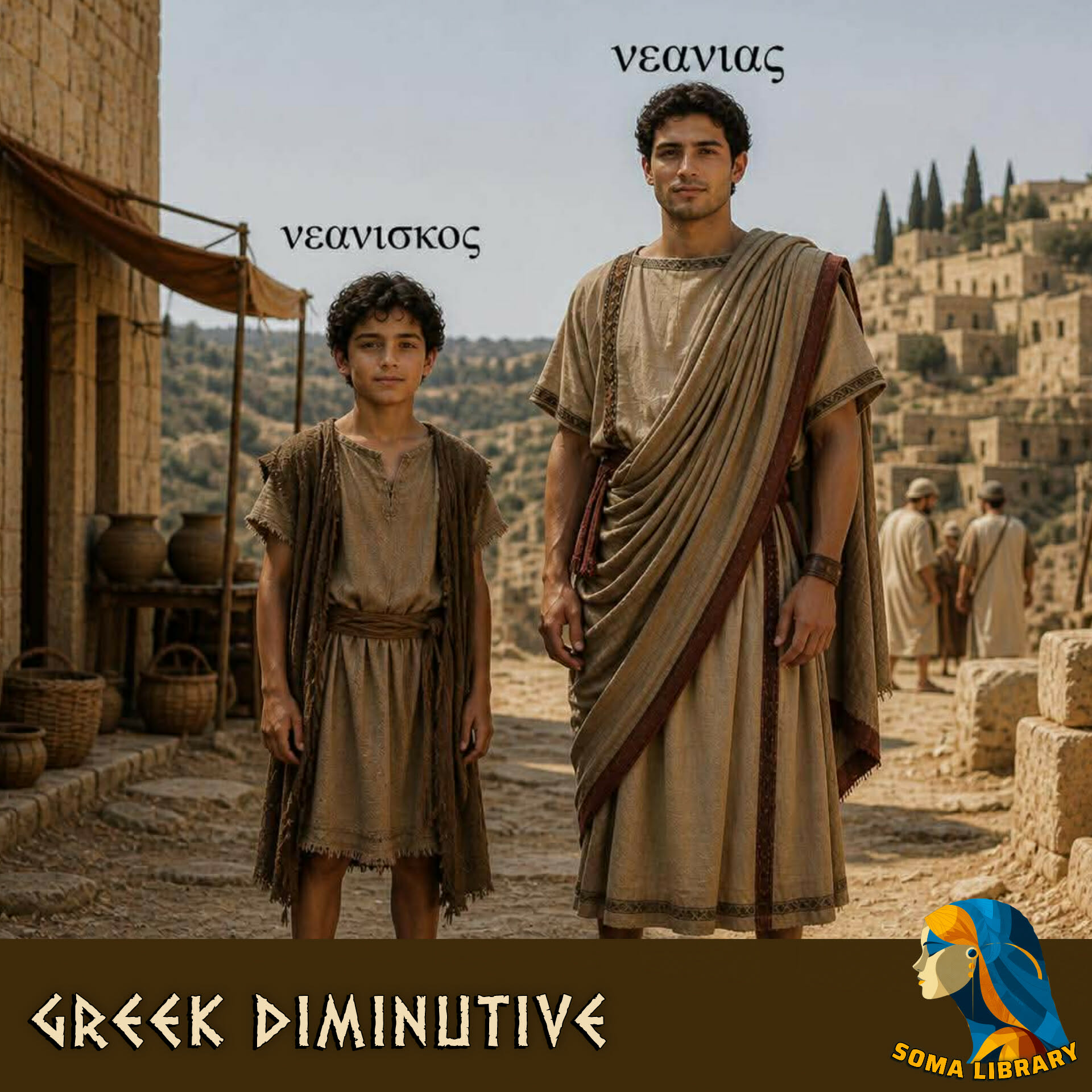
The Ancient Greek Diminutive: Understanding the Force of -ισκος
Ancient Greek possesses a rich system of diminutive formation, a grammatical device by which a noun is reshaped to indicate something smaller, younger, lesser, dearer, or more contemptible than its base form. Rather than introducing an entirely new lexical object, the diminutive modifies the original noun from within, signaling a reduced or altered version of the same thing. In English we occasionally preserve traces of this process in forms like booklet or piglet, but Ancient Greek employs diminutives far more productively and with much greater semantic nuance.
Among the most common and expressive of these endings is the suffix -ισκος (-iskos), with its feminine -ισκη (-iskē) and neuter -ισκον (-iskon). When attached to a noun stem, this suffix typically marks the referent as small in size, young in age, slight in rank, or diminished in social standing. Thus φαλλός (phallos, phallus) becomes φαλλίσκος (phalliskos), “a little phallus”; ἀνήρ (anēr, man) becomes ἀνδρίσκος (andriskos), “a little man” or “insignificant fellow”; and νεανίας (neanias, youth) becomes νεανίσκος (neaniskos), not simply “a youth,” but literally “a small/little youth,” “youthling,” or “junior boy.”
This is not mere decoration of speech. The diminutive in Greek often carries a strong evaluative judgment. Depending on context, -ισκος can imply smallness, tenderness, familiarity, triviality, inferiority, or even disdain. A diminutive form may indicate that the speaker views the object as physically small, socially subordinate, immature, or unimportant. In literary and colloquial usage alike, the suffix therefore does far more than indicate size: it subtly informs the hearer how the noun is to be regarded.
Grammatically, this process belongs to what philologists call derivational morphology - the creation of a new word by attaching a meaningful suffix to an existing lexical stem. This distinguishes it sharply from compound constructions such as English butterfly or Greek ἱπποπόταμος (hippopotamos, river-horse), where two independent stems are fused together. In a diminutive, the suffix itself contributes the semantic reduction. A νεανίσκος remains a νεανίας, but a reduced one: younger, smaller, or lesser by implication.
Because Ancient Greek authors chose these forms deliberately, diminutives deserve close attention in textual interpretation. They are rarely neutral. When a writer selects -ισκος, he is often signaling more than mere description; he is placing the noun into a social and psychological frame of diminishment. To ignore the suffix is to flatten the force of the word. To hear it properly is to hear the author’s judgment embedded directly into the grammar.
Examples:
- neaniskos (νεανίσκος) - small neanias / youth
- phalliskos (φαλλίσκος) - small phalus / penis
ButterFly?
Iskos (as in phalliskos) is a completely different type of grammar/ part of speech, than "fly" (as in butterfly)
butterfly is lexical compounding (compound noun formation)
- butterfly is not a type of butter.
- exocentric or opaque compound, where the total meaning is not reducible to either part.
- The two words merely contributed imagery at origin.
-ισκος (-iskos) is derivational suffix morphology (diminutive morphology)
- νεανίσκος is still fundamentally a νεανίας
- subtype of νεανίας, this is called endocentric derivation.
- the derived form still belongs to the same semantic family as the base.
Ancient Greek also has compounds like butterfly
Greek does this too - all the time.
This is not foreign to Greek at all.
Examples:
- ἱπποπόταμος = horse + river = hippopotamus
- νυχτερίς = night-creature
- χρυσόμυια = gold-fly
- κυνόμυια = dog-fly
- σκατοφάγος = dung-eater
Can compounds and suffixes mix? Yes.
Languages often stack both processes.
You can have:
- compound first, then diminutive
- diminutive first, then compound.
Greek examples:
- παιδοτρίβης = boy-trainer (compound)
- παιδοτριβίσκος = little boy-trainer / minor pedagogue (compound + diminutive suffix)
So morphology can layer.
See Also
- Neaniskos - on the diminutive in Neaniskos